

Join the Sullivan Lab at Trent University
Ryan Sullivan named Eddie Goldenberg Research Chair of Canada at Trent University
Ryan Sullivan is moving the research group to Trent University in Peterborough, Ontario, Canada, in January 2027. He will hold the Eddie Goldenberg Research Chair of Canada in Environmental and Sustainable Chemistry, with appointments in the Department of Chemistry and the Trent School of the Environment. The Chair provides $8 million over eight years to build and support a world-class research program, and the Canada Foundation for Innovation provides a further $4 million for infrastructure, facilities, and research equipment. Read Trent's announcement.


Trent University's Symons Campus on the Otonabee River. Photo: Trent University.
At Trent, the group will study how chemicals transform in the environment at the molecular level, and use that understanding to design safer chemicals and new water treatment technologies. A mechanistic focus links our four research themes: we determine reaction mechanisms, kinetics, and transformation products directly, often in single particles and droplets and at interfaces, where chemistry differs sharply from that in bulk solution. The themes are:
- Atmospheric chemistry, including wildfire smoke chemistry, aerosol–cloud–climate interactions, and the multiphase chemistry of individual aerosol particles: how reactive uptake of trace gases alters particle phase and morphology, and how those changes feed back on chemical reactivity
- Aqueous photochemistry, photosensitization, and transformation products, to predict how synthetic chemicals transform and persist in the environment
- Sustainable chemistry and safer chemical design, assessing the hazards of new chemicals and their transformation products before large-scale production
- Contaminant remediation chemistry for water treatment and reuse, including technologies that destroy persistent organic contaminants through aerosol-accelerated chemistry
Our main experimental and computational approaches include:
- Single-particle and single-droplet techniques, including aerosol optical tweezers, droplet microfluidics, and single-particle analysis
- High-resolution mass spectrometry coupled to liquid and gas chromatography, with nontarget analysis to identify transformation products and unknown contaminants
- Atmospheric reaction chamber experiments with real-time chemical ionization mass spectrometry and aerosol instrumentation
- Aqueous and atmospheric photochemistry, including solar simulators, photoreactors, and transient absorption spectroscopy
- High-throughput reaction kinetics in well plates using laboratory automation
- Computational modelling of chemical properties and environmental fate, with Trent's Canadian Environmental Modelling Centre
- Extensive use of Trent's Water Quality Centre, the most comprehensive mass spectrometry facility in Canada, including the first FT-ICR-MS for ultrahigh-resolution mass spectrometry
Across all four themes, we ask what reactions occur, which reactants drive them, how fast they proceed, and what transformation products form.
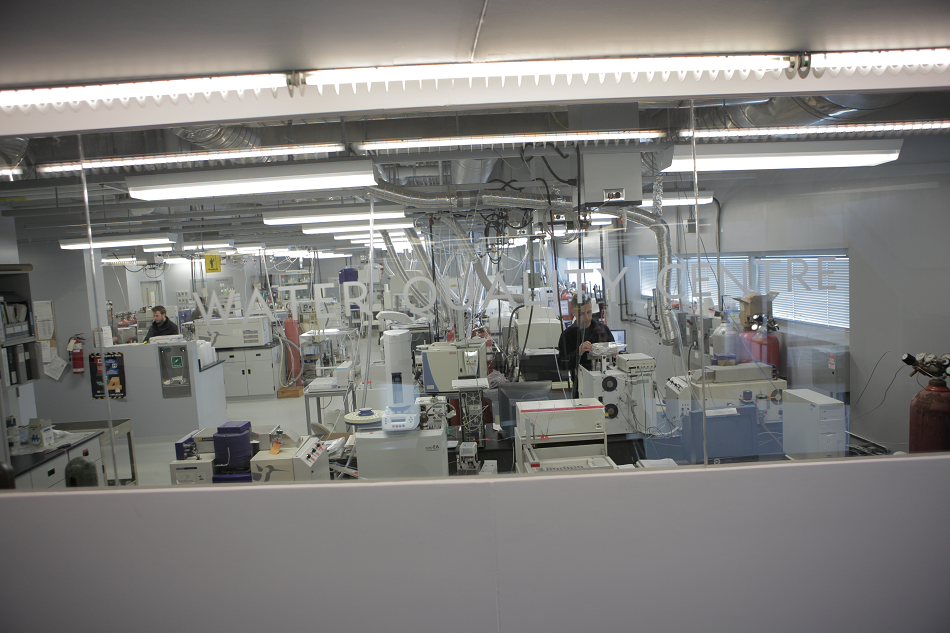

Left: the Water Quality Centre, the most comprehensive mass spectrometry facility in Canada. Right: the Chemical Sciences Building, home of the Department of Chemistry and the Water Quality Centre. WQC photo: Trent University. CSB photo: courtesy of Teeple Architects.
Trent University is widely recognized for its strengths in interdisciplinary environmental research and education. Its Water Quality Centre and Canadian Environmental Modelling Centre give the group direct access to advanced mass spectrometry and chemical fate modelling. Peterborough is about a 90-minute drive from Toronto.
New group members will join us at Trent University, where we move in January 2027. We are recruiting MSc and PhD students, postdoctoral associates, and a lab manager to begin as early as February 2027. Details and the application form are on our new group site.
Open positions and how to apply
Position descriptions, eligibility, and the application form are on our new group site.